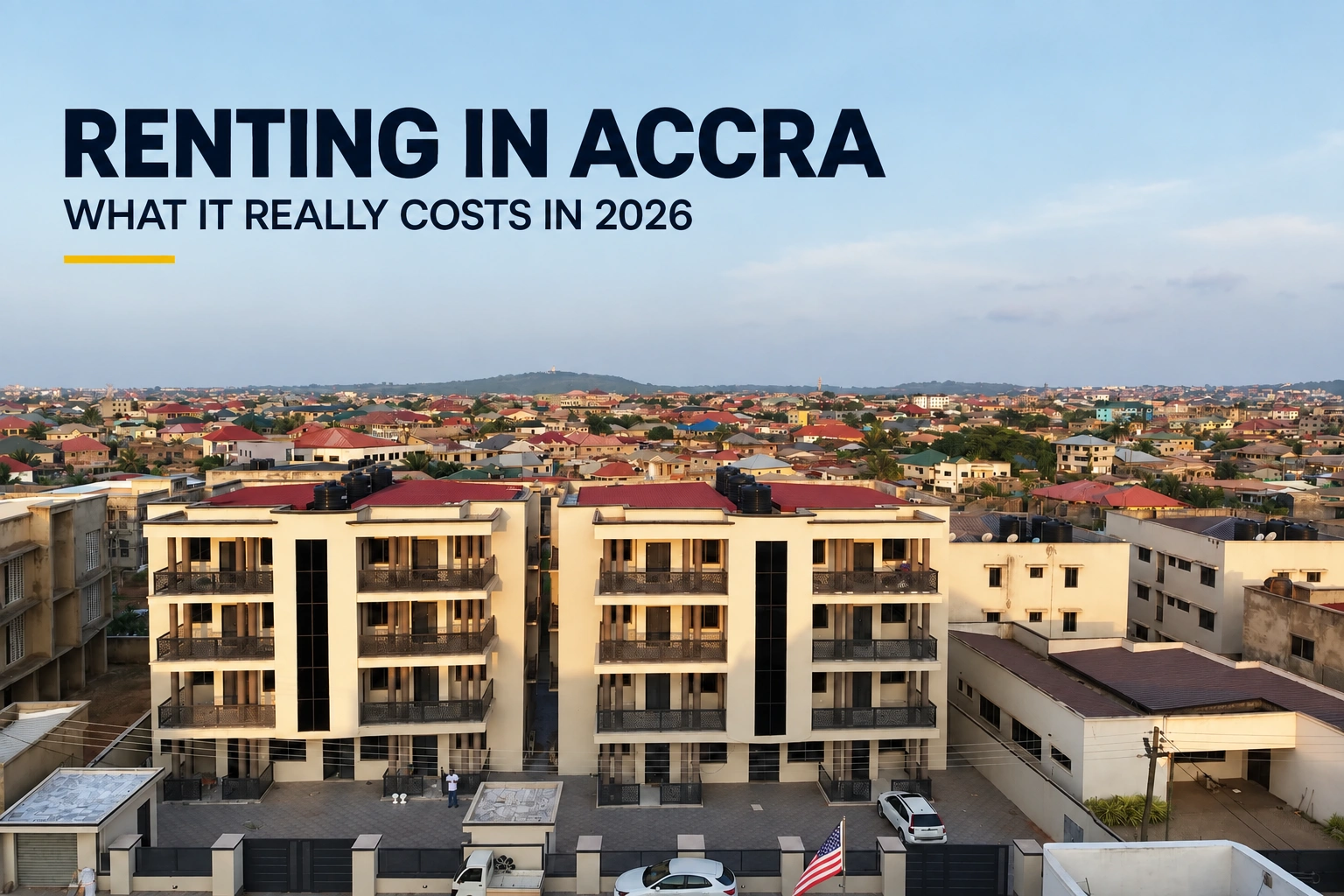
You found the apartment. You like the pictures. The rent looks manageable. Then someone tells you how much you actually need to move in.
Welcome to renting in Accra.
If you are currently searching for a house in Accra, you have probably realised that asking, “How much is rent?” is only the beginning of the conversation.
The more important question is:
“How much will it actually cost me to live here?”
Because a GH₵4,000 apartment can easily cost you far more than GH₵4,000 to move into and maintain.
And depending on where you want to live, the type of property you want, whether it is furnished, and how close you need to be to the city centre, the difference can be significant.
So, what should you realistically expect to pay to rent a house in Accra in 2026?
Let’s break it down.
There isn’t one price for “rent in Accra.”
The city has a wide range of neighbourhoods, property types and tenant profiles, so prices can vary dramatically.
As of June 2026, Ghana Property Centre’s market data puts the median asking price for apartments in Accra at approximately GH₵4,600 per month, compared with about GH₵3,800 in June 2025. That’s an increase of roughly 17% year-on-year.
But once you break it down by apartment size, the picture becomes more useful.
Current median listing prices are approximately:
|
Property type |
Approx. median monthly asking rent |
|
1-bedroom apartment |
GH₵3,700 |
|
2-bedroom apartment |
around GH₵4,500–GH₵4,600 |
|
3-bedroom apartment |
around GH₵6,200 |
These figures should be treated as market indicators, not fixed prices. The actual rent you encounter can be significantly lower or higher depending on the neighbourhood, condition, amenities, furnishing and other factors.
And that is where things get interesting.
Because a person looking for a GH₵3,000 apartment is shopping in a very different market from someone with a GH₵10,000 budget.
Let’s make this practical.
If Your Budget Is Around GH₵2,000–GH₵3,000 Per Month
You are generally going to be looking at the more affordable end of Accra’s rental market.
Depending on location, you may find:
This is where location becomes extremely important.
You may find a property at this price point, but it might come with a trade-off:
distance, size, age, finishing, amenities or accessibility.
And that’s not necessarily a bad thing.
If you work remotely, don’t commute every day, or have your work and family commitments in a particular part of Accra, a more affordable neighbourhood may make perfect sense.
The mistake is assuming that a cheaper property is automatically a better deal.
It isn’t.
This is where a significant portion of apartment seekers will find themselves.
At this budget, you can start looking more seriously at:
But again, GH₵5,000 in one part of Accra does not buy the same thing as GH₵5,000 somewhere else.
A GH₵5,000 budget may give you a relatively modern apartment in one neighbourhood, while in another area you may need GH₵7,000, GH₵10,000 or more for something comparable.
For example, current listing data places East Legon’s median apartment asking rent at about GH₵5,900 per month, while Airport Residential Area is considerably higher at roughly GH₵7,400.
That is why simply asking:
“What is the average rent in Accra?”
can be misleading.
The better question is:
“What does my budget get me in the area where I want to live?”
Once your budget moves into this range, the number of options can increase considerably.
Depending on the location, you can start seeing:
But there is an important trap here.
More money does not automatically mean better value.
A GH₵7,500 apartment isn’t necessarily a better investment of your money than a GH₵5,000 apartment.
You are paying for a combination of:
Location + space + finishing + amenities + convenience + security + demand.
The question is whether those things actually matter to you.
At this level, you’re increasingly entering premium and luxury rental segments.
You may find:
Neighbourhoods such as Airport Residential Area, Cantonments, Labone, East Legon and other prime locations can command significantly higher prices.
But there is another important consideration here:
Furnished and serviced properties can distort the simple rent comparison.
A GH₵10,000 furnished apartment isn’t directly comparable with a GH₵7,000 unfurnished apartment.
The furnished property may save you a significant amount of money and effort on furniture, appliances and setup.
So compare the total value, not just the advertised rent.

This is probably the biggest lesson we want renters to take away from this article.
Imagine you find a two-bedroom apartment advertised at:
GH₵5,000 per month.
You might think:
“I can afford GH₵5,000.”
But can you afford the entire cost of occupying the property?
You may have to account for:
How much you have to pay upfront can completely change your affordability calculation.
Ghana’s official Rent Control platform states that the legal maximum for advance rent is six months. But you and I know property owners charge atleast a year.
So if the rent is GH₵5,000, six month or a year advance represents:
GH₵30,000/60,000 upfront. – Depending on the arrangement with the landlord.
That’s before you consider other costs.
And this is precisely why renters should calculate their move-in cost, not simply their monthly rent.
If you are using an agent, there may be an agency fee associated with finding and securing the property.
Understand exactly:
And always ask for clarity before committing money.
Some properties may require a refundable security deposit or other upfront payments.
Don’t assume.
Ask.
This one catches people off guard.
A modern apartment may advertise a seemingly reasonable rent, only for the tenant to discover that there is an additional service charge.
Depending on the property, this may contribute towards:
Always ask:
“Is the service charge included in the rent?”
If it isn’t, ask exactly how much it is.
Then There Is the Cost of Living Around the Property
This is where the conversation becomes more interesting.
Suppose Property A costs GH₵4,000.
Property B costs GH₵5,000.
Most people will immediately say:
“Property A is cheaper.”
Maybe.
But what if Property A requires you to spend an extra GH₵1,500 every month on transportation?
You have just erased the rent advantage.
And what if Property B is 15 minutes from your workplace while Property A takes an hour?
Now you’re also paying with your time.
So when comparing rental properties, consider:
Rent + transport + utilities + service charges + maintenance + lifestyle costs.
That is your true housing cost.
Accra’s rental market is incredibly location-sensitive.
The closer you move towards established prime and business-oriented neighbourhoods, the more you should expect to pay for comparable properties.
Current listing data illustrates this difference.
For example, Ghana Property Centre’s June 2026 data reports median apartment asking prices of approximately:
These are based on the listings available in those areas, so they should be viewed as indicators rather than universal neighbourhood prices.
This is why one of the smartest things you can do as a renter is to expand your search radius.
If your preferred neighbourhood is too expensive, don’t immediately increase your budget.
First ask:
“What neighbouring areas give me similar access for less?”
Sometimes moving a few kilometres can make a meaningful difference.
Should You Live Close to Work?
This sounds obvious, but many renters underestimate it.
Let’s say you earn GH₵15,000 per month.
You could choose:
Apartment A: GH₵3,500 rent, but a long daily commute.
Or:
Apartment B: GH₵5,000 rent, but much closer to work.
The second property costs GH₵1,500 more in rent.
But if it saves you:
the difference may not be as large as it first appears.
The cheapest house isn’t always the cheapest lifestyle.
This depends entirely on your situation.
If you already own furniture and appliances, an unfurnished apartment may make more sense.
But if you are:
a furnished apartment can sometimes make more financial sense.
Think about what it would cost you to furnish the property yourself.
Sofa.
Bed.
Wardrobes.
Fridge.
Washing machine.
TV.
Dining table.
Curtains.
Kitchen appliances.
Generator or backup power solutions.
Suddenly, the “more expensive” furnished apartment may not be as expensive as it looks.
This is where renters should pay attention.
If your budget doesn’t stretch to East Legon, Airport, Cantonments or Labone, don’t assume you have to compromise on everything.
Areas further from the traditional prime core can offer significantly more space for your money.
You might consider locations such as:
Oyarifa.
Abokobi.
Adenta.
East Legon Hills.
Ayi Mensah.
Lakeside.
Spintex.
Tema.
And several other emerging residential corridors.
The right choice depends on where you work, your family situation, your transport needs and the kind of lifestyle you want.
The question isn’t:
“Is this neighbourhood prestigious?”
Ask:
“Does this neighbourhood work for my life?”
That’s a much better way to choose a home.
As a very broad 2026 guide, renters can think about the market like this:
|
Monthly budget |
What you may typically be looking for |
|
GH₵1,500–GH₵2,500 |
Smaller/older apartments, self-contained units and more affordable locations |
|
GH₵2,500–GH₵4,000 |
1-bedroom apartments and selected 2-bedroom options depending on location |
|
GH₵4,000–GH₵6,000 |
Stronger selection of 1- and 2-bedroom apartments, with some 3-bedroom options |
|
GH₵6,000–GH₵10,000 |
Better-finished 2- and 3-bedroom apartments, gated communities and premium locations |
|
GH₵10,000+ |
Premium/luxury, furnished and serviced apartments and larger homes |
These are planning ranges, not fixed market prices.
The actual price can vary dramatically by location, property condition, furnishing, amenities and landlord.
The market data supports that variability: even within Accra, current listings span a very wide range.
This is where we would encourage renters to think beyond the usual “30% of income” rule.
Ghana’s rental market doesn’t always cooperate with neat budgeting formulas.
If you earn GH₵10,000 and live in a neighbourhood where comparable housing costs GH₵4,000, telling yourself that you should only spend GH₵3,000 doesn’t magically create a GH₵3,000 apartment that meets your needs.
Instead, think in terms of:
Affordability + Location + Lifestyle + Total Cost
Ask yourself:
How much can I comfortably commit to housing every month?
How much cash do I need upfront?
What will transport cost me?
Are there service charges?
What utilities will I pay?
How much will furnishing cost?
How long do I intend to stay?
Those questions will give you a much more realistic housing budget.
Before You Pay for That Apartment, Ask These 10 Questions
Don’t send money simply because you like the property.
Ask:
If the answers aren’t clear, slow down.
It isn’t necessarily paying too much.
It is making the decision based on rent alone.
A GH₵3,000 apartment can be expensive.
A GH₵5,000 apartment can be affordable.
A GH₵7,000 apartment can even be better value than a GH₵5,000 apartment.
It all depends on what you’re getting and what the property costs you beyond the rent.
So don’t ask:
“What’s the cheapest apartment I can find?”
Ask:
“What’s the best home I can get within my total housing budget?”
That one change in mindset can save you a lot of money — and a lot of frustration.

If you’re looking for a home this year, expect competition, variation and negotiation.
Rental prices have moved upward in many segments, but the market isn’t uniform. Some categories are moving faster than others, and some neighbourhoods remain considerably more expensive than others. For example, current data shows 1-bedroom apartment asking prices in Accra up substantially year-on-year, while 3-bedroom apartment asking prices were comparatively stable over the same period.
That tells us something important:
There isn’t one “Accra rental market.”
There are many markets operating within Accra.
And your job as a renter is to find the one that works for you.
If you’re renting in Accra in 2026, don’t start your search with a property. Start with a budget.
Then define:
Where you need to be.
What you actually need.
What you can pay upfront.
What you can comfortably pay every month.
What you’re willing to compromise on.
And finally:
What represents good value for you.
Because the perfect house isn’t necessarily the most expensive one.
It isn’t necessarily the cheapest one either.
It’s the one that gives you the right combination of price, location, space, convenience and quality — without putting your finances under unnecessary pressure.
At Bizimodation, that’s how we think about real estate.
Not just finding you a property. Helping you make sense of the property you’re choosing.
Because in a city as diverse and fast-moving as Accra, finding a house is one thing. Finding the right house is another.
And that’s exactly what we’re here to make easier.

We simplify real estate. From initial consultation to closing day, we guide you through every step with clarity and ease.
WhatsApp us